Saturday, April 30, 2011

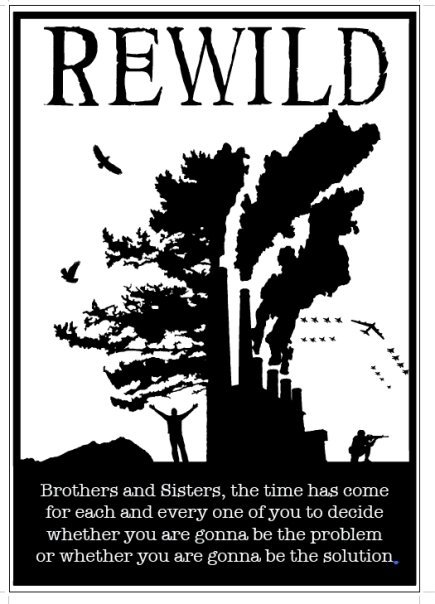
Rewild


I love this idea. Imagine: the process of rewilding the urban world, going back to a time when nature ruled. It reminds me of the series Life Without People, and the book The World Without Us, both very intriguing! I would actually prefer to see the world transition back to this state. The idea of nature fighting back is encouraging to me! It shows that there is hope!

Friday, April 29, 2011

Views from a Barcelona Streetcar in 1908


This is quite an inspiring film! You just don't see streets as active as this anymore; people moving every which way- feeling as if they are a part of the city! These days, if we're lucky enough to have pedestrians outdoors, they're hugging the buildings in order to steer clear of the traffic!

Wednesday, April 27, 2011

Before 2050

The urgency that presses behind the need for positive environmental action is somehow forgotten when advocates for sustainability argue their points. Not only is it crucial that we change our behavior, but we must do so immediately. Many forecast, as I believe, that the Earth will reach it's carrying capacity by 2050, rendering it unable to support its inhabitants. Some scientists actually suggest that the planet will be "unrecognizable" by 2050. To me, this concept is unimaginable and quite disheartening! (1) If we do not act quickly, we are doomed to enter a world-wide environmental depression that endangers our lives and the life of planet Earth. As alarming as this may be, there is hope, still, for this prediction still allows for ample time to change.

Population is growing; this is difficult to control but humans must be more conscious of and deliberate in the decisions they make, as well as the impact these decisions have on the population of the world as a whole. I would rather save the choice/life discussion for another day, but I will gently recommend people consider the loss of life caused by unplanned, irresponsible life. The brutal fact is that there used to be extreme population controls, such as war or fatal diseases. As humans become healthier and safer, and technology extends the human lifespan, we flood the planet with more life than it can support. It wont be long before we are overpopulated and Earth will be unable to provide for us. The large issue brought about by the population dilemma is about the resources we waste and exhaust. "A study by the World Wildlife Fund (WWF)... warns that the human race is plundering the planet at a pace that outstrips its capacity to support life." (2)

With such extreme levels of consumption, we are condemning our planet and home. The same report explains how humans worldwide have destroyed a third of the natural world over the past three decades. In the energy we invest in competing to have the best technology, best cars, and largest homes it's almost as if we are racing to see how quickly we can obliterate the planet when we should be investing all of our energy in opportunities to preserve and save it.

But I refuse to picture a future without nature. I refuse to accept that this is the path we are stuck along. It will take more than a few changes by one person to change this path, but I am dedicating my entire life to saving our planet, as are others. Before it's too late, we must all take action and accept responsibility as the stewards of this planet.

1. http://www.populationmedia.org/2011/04/07/planet-could-be-unrecognizable-by-2050-experts-say/
2. http://www.guardian.co.uk/uk/2002/jul/07/research.waste

Monday, April 25, 2011

More posts will come soon...

I promise I'll write more soon. One post a week has proven to be harder than I imagined, but still, I should be able to write more frequently.

Recently, however, I have been busy. I've been much more active in the community, I've attended many lectures, presentations, etc. and I've been involved in volunteer opportunities. On top of that, last week was Baltimore Green Week, of which I spent each evening at an event learning about sustainability in Baltimore, and I received my acceptance letter to the Master of City and Regional Planning program at Morgan State University. I'll be specializing in Urban Design and Sustainability. But first, I need to figure out how to pay for my education!!!

Here's a start, a humble request for sponsorship! http://www.sponsormydegree.com/meganschwartz

Saturday, April 23, 2011

Earth Day


Hope everyone enjoyed Earth Day 2011! May the efforts continue for the other 364 days of the year!

And here's a clever little animation featured on Mother Nature Network for you:

Wednesday, March 23, 2011

Baltimore Ciclovía, Periodic Event or Established Program


It could have been via luck- something I never have- or chance that an invitation to a meeting on the 3rd Baltimore Ciclovía was extended to me. As I sat in a room of maybe a dozen people, among those who seemed to be of an exclusive group of appointed members, I learned so much more about ciclovias and the process than I anticipated. I entered knowing very little about what a ciclovia even was, but left with anticipation and excitement about the direction in which our city could be headed.

Two years ago, on October 25, 2009, Baltimore held it's first ciclovía, or Sunday Streets Program. It was the first city on the East Coast to launch ciclovía. Organized by The BMore Streets for People Coalition, this event was intended to spark interest within the city for hosting a series of ciclovías, perhaps every Sunday in the Summer, or a few Sundays in a year. Last October, the second event was hosted. Being scheduled on Halloween may have hurt the event more than they anticipated, but there is an opportunity to build even more support as they plan an event for May 15, 2011.

Ciclovía translates from Spanish to mean "bike path," but the programs of most ciclovías includes more than usage by bicycle. More than opening the streets for pedestrian use, the ciclovía is about closing the streets to automobile traffic. The Ciclovía, though a basic concept, is usually accredited back to Bogotá, Colombia. Having started in one city back in the 1980s, the ciclovía has come a long way. Today, there are a number of ciclovías throughout six countries across the world. At least 18 cities in the United States have held or continually hold ciclovía type events.

The main issues the advisory board of the Baltimore ciclovía encountered were of funding and security. The need for security seemed questionable by most in attendance, though it appears this is more a concern of the city than the board. And the need for funding was rooted mostly in the need for security. Without the cost for security, a ciclovía could afford operation with only the funding from the local businesses along the route. Though some businesses may be hesitent at first, they'll begin to notice increased sales due to the ciclovía.

At first, security might be a good idea. Drivers not expecting a road closure could get frustrated. Lack of proper barricading could leave pedestrians open to the risk of an accident. But with the right amount of barricading, which can be figured out by looking at the Baltimore marathon that closes down 26 miles of city streets, the need for strict security could be relaxed. And rather than pay police or crossing guards, the city could train STEOs (Special traffic enforcement officers). Cheaper, and easier than city police. Or, we could operate like Miami does, where Police Officers volunteer for these events.

By following the examples of Miami and other cities hosting ciclovías, it wouldn't take much to transform the Baltimore Ciclovía into a continuous event. In Portland, OR, residents enjoy Sunday Parkways. Funded by sponsors and donors, and held together by 300 volunteers, Sunday Parkways connects people from all neighborhoods.
In New York, rather than Sunday Streets, you'll find "Summer Streets", on 3 consecutive Saturdays in the Summer of 2010.

In 2008, San Francisco hosted its first ciclovia. For 2001, they already have 8 events planned. The San Francisco Sunday Streets program has an event each month. Like many others, this event relies on donations and volunteers in addition to sponsorship from the government.
With these, and many other precedents, it shouldn't be hard for Baltimore to build a program that endures. Last week, I knew virtually nothing about ciclovías. In one week, I have come to discover the wonderful benefits of holding ciclovías and have built great interest in promoting it in my own city.

Wednesday, March 16, 2011

Ecological Urbanism


On Thursday, March 20, 2011, AIA Baltimore held the first of four lectures to be a part of this year’s Spring Lecture Series. Martin Felsen, of UrbanLab, presented Civic Spaces through Ecological Urbanism. In his speech, Felsen emphasized that a large part of ecological urbanism needs to be building our cities around green infrastructure. The bulk of his presentation conveyed ways in which our city water systems could be better managed.

UrbanLab is a Chicago based firm largely involved in rethinking the city’s design. The main point of Felsen’s lecture, and the topic he was most thrilled to discuss, was issues involving water usage and how green infrastructure offer a solution. In the city of Chicago, water is sourced from Lake Michigan, part of the Great Lakes, which make up 20% of the world’s freshwater supply. Rather than return what water the city takes from the lake, the water instead ends up in the Gulf of Mexico. This amount of water taken, if not replenished, could result in the shrinking of Lake Michigan. Just such a misfortune happened with the Aral Sea. In 20 years, the Aral Sea shrunk to 10% its original size. To avoid similar destruction in Lake Michigan, Felsen suggests the right measure is to design our city infrastructures so that rain water is absorbed into the ground, rather than directed into our sewers and thus out of our ecosystems. My thesis project addressed this is on a small scale through the design and incorporation of rainwater catchment systems and green infrastructures that kept rainwater out of the sewers.
An image from my thesis, Sustaining Cockeysville

The technology I used, and some of the technology Felsen suggested, is based off of systems currently being used in cities like Portland and Seattle.

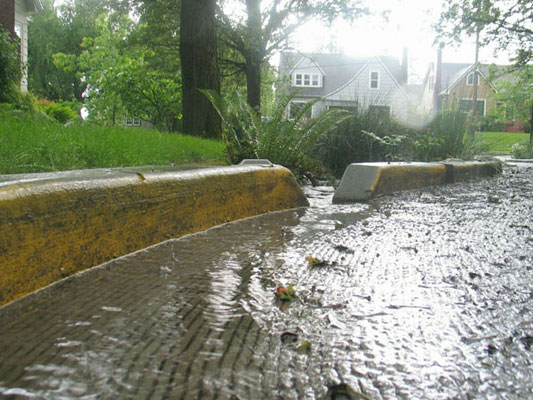
An image of Portland's Green Streets Program

In the Baltimore area, there are parts of the county currently utilizing green storm water management technologies. The Eastern Boulevard (MD 150) Median Design features a bioswale to collect rain water. What was different about Felsen’s proposal for Chicago, however, was that it was to be implemented on a much more extensive scale. With his eco-boulevards, rainwater follows green pathways back to the lake. The eco-boulevards follow Chicago streets that lead to Lake Michigan. Entirely greenscaped or spotted with parks, trees, and green infrastructure, the eco-boulevards are funded by the money already set aside to upgrade existing streets. The eco-boulevard was an inventive concept I’ve never seen before. And not only does it address the issue of poor water management, but it provides necessary public space. Most cities are 40% infrastructure, as Felsen explained, which means the population collectively owns it. With that control, we ought to return the space used for automobiles to pedestrian zones. As for blackwater, Felsen’s Living Machines would treat sewage prior to sending it back to the lake. The Living Machine is an existing technology that uses the bacteria of ecosystems to naturally clean sewage. These two technologies together, the eco-boulevard and the living machine, are part of Felsen’s project Growing Water.

The water crisis is a concerning issue. The proposals presented by Felsen and UrbanLab are brilliant solutions that can be reasonably implemented. The façade, behind which the ideas were presented, however, took some of the charm. Before hearing Felsen speak, I was a little turned off by the exceedingly modern designs created by Felsen and UrbanLab. There are times when I feel discouraged by what I am seeing in the majority of ecological architecture and design projects. Nearly every “green” project or concept I come across is set within an abrasively modern design. Their designs are overly simplified to the point where nothing stands out, not even the concepts they present. It almost seems as though designers who are hoping to gather support for ecologically valuable projects create their work in a way they assume appeals to the less environmentally inclined public, as if those people would only accept the most sterile looking, modern designs- as if that style of architecture symbolized something elite and trendy. I might, however, argue the opposite. I have known very few people to actually appreciate modern architecture, because the primary purpose of modern architecture seems to serve only the ego of the architect. The modern versus traditional battle always reminds me of criticism I received for my thesis. As I planned my design, I drew inspiration from the traditional architects before me. My professors continually urged me to “think outside of the box,” claiming I needed to be more original with my design. But my design wasn’t what was important, what my project addressed was important. The designs of traditional architecture best attended to the issue at hand. The classic elements I returned to were naturally more energy efficient. Meanwhile, the designs of all of my classmates were literally within the box: overly simplified structures with flat facades that served no purpose. My only criticism of Felsen’s presentation- and the same goes for all forward-looking designers- is the same as what my professors once told me. Think outside the box. if you present a cutting edge concept that has the potential to better our world, step outside of the glass box design. After all, how can we get others excited about good design if our designs have nothing exciting about them? Still, I am excited about the concepts and theories behind the designs and, although I’m not a fan of the style, I wholly support the projects.

Martin Felsen and the work being done at UrbanLab are certainly worth taking a look into. Like many other resources we depend on, water is being used up faster than we can replace it. Without solutions like the ones proposed by Felsen, we could face a serious impasse that would leave many in crisis. Though it would have been refreshing to see more complex designs, it does not overshadow the solutions Felsen presented to a complicated problem.