Saturday, February 11, 2012

Hoping for Howard Street

Yesterday, I took a long walk along Howard Street. Despite the handful of stable areas of Baltimore, this is actually the part of the city that I frequent the most. The Light Rail has much to do with that. Taking the light rail to get to destinations elsewhere in downtown Baltimore had introduced me to the old retail corridor. And of course, it makes access to Howard Street easy, so I can visit time and time again. But I've never taken as close a look as I did yesterday.

This semester, my urban design course will be looking at this corridor. While I've been there dozens of times in the last few months alone, I rarely look deeply at the obvious wounds and scars. Instead, I usually admire how beautiful the architectural detail is on each crumbling building, and my imagination takes me to a place I've only ever been told about, a thriving retail center for an entire region. It must have been wonderful, and I've seen photographs that certainly look inviting! Today, however, it's nothing like it used to be. While businesses are speckled among the first floors of some buildings, most appear to be struggling, and very few cater to everyday needs. Furthermore, above these establishments, the remaining 3 or more floors of each building are left vacant. Interjecting between the storefronts is a threatening wall of plywood, blocking off the entirely vacant structures. Some blocks are better off than others, sometimes even one side of the street is more fortunate than the opposite, but the overall feeling is one of despair.

In front of the old Mayfair Theater
The architecture has always been of great stock, but as Baltimore Slumlord Watch described after a recent trip much like the one I took yesterday, most of these structures have been neglected for so long that the damage can not be reversed. The sidewalks are a good size, often brick, and for the most part attractive, yet tree wells are left empty and the public space seems missing. Thus, the streetscaping elements are, for the most part, lacking. The most redeeming quality of the space, in my personal opinion, was the abundance of street art. Not graffiti, but street art- intended to deliver a message, not always a pleasant one. I had the opportunity to speak with a Baltimore resident who had recently come here from Africa in the last few years. He noticed me taking photographs of one piece of art and had to ask why I was so interested in the piece. I asked his opinion and he said he preferred the look of the dated movie posters just ten feet away. I explained to him how I felt the messages delivered by art in a raw form like this were beautiful, more so than the marketing and advertising of the poster. We're drowning in advertising, and the motives are always very selfish, whereas the street art pasted on these plywood walls had been put there by the artist so that the community could benefit. I'm not sure if I convinced him or not, but he did walk away from our conversation excited about art in general.

The art in question, raw street art, or movie posters?
While the art was beautiful, it was set against a saddening backdrop. The only hope that the city has tried invoke from the community has come from their attempts to transform this area into the same high end retail spot it was decades before. I don't think that can be done, nor do I think it should be done. This area has changed, the population has changed, and the purpose has changed. We can make steps in that direction, but we can't forget about who or what is there now. The area needs to transform to meet their needs.


An absolutely beautiful piece of street art fronting Franklin

Served well by transit, this area has so much opportunity to be a destination for all city residents, to draw suburbanites into the downtown area, and to serve the current residents of the area. There is much to be done.

Tuesday, February 7, 2012

Cleaning and Greening in Baltimore City

This semester, I am fortunate enough to be working as a graduate assistant under my department chairperson of the City and Regional Planning Program. If I have not yet mentioned this before, I'm a student at Morgan State University, an HBCU in  Baltimore. So far, the program has been terrific, and this, my second semester, has already proven to be exciting. Most of the excitement comes from a university-wide initiative to reconnect our school with the surrounding community. This is the project for which I am assisting my chair. We have an economic development grant and are researching and evaluating the communities surrounding MSU. These communities make up most of the Northeast quadrant of  Baltimore city. Yesterday, we held a board meeting with representatives from local community associations. At this meeting, I had heard so many varying viewpoints, and learned so much about this city.

 I was actually surprised to hear about the rising interest in some of the things that an environmental urbanist values: buying local, eating organic and healthy, and keeping the city green.A few years ago, Baltimore City launched the initiative "Cleaner, Greener Baltimore." Unfortunately, it hasn't gotten as much media hype as many would have hoped. But that doesn't mean that city residents haven't taken it's values to heart. Whether or not they do it for sustainability or environmental issues, city residents are actively "cleaning and greening" their neighborhoods. Sometimes, the city will be able to pay for these activities, but when the city can't, the residents fork up their own dollars to bring dumpsters in to dispose of recyclables and waste.

There are numerous other initiatives and programs in the city. Most weren't created for sustainability reasons, but all immediately effect the environment in positive ways. The Vacants to Value program enacted by Mayor Rawlings Blake encourages vacant spaces- which often become dumping grounds for trash- to be revitalized and occupied. This improves the livability of our city, making it a more viable place to live and invest in. The Department of Transportation (DOT) has also been "greening" the streetscapes by implementing storm water management technologies. These were introduced to control our cities terrible storm water issues (due to the extreme lack of natural and porous surfaces), and it's definitely a wonderful program for people like myself, who hope to see even more environmental initiatives pop up over the years, to hear about.

The assistantship will hopefully continue to expose me to the many different programs and opportunities Baltimore currently has that benefit the environment while at the same time strengthening our city.

Wednesday, February 1, 2012

Reduce, Reuse, Recycle

I'm currently applying to the Castle Ink Paperless Scholarship to help me fund my education- which, by the way, is why I haven't been able to post much lately! I'm earning my Master's Degree in City and Regional Planning and specializing in Sustainable Cities. I truly love learning about this stuff, and I can't wait to apply my knowledge.

To fund my school, I've begun looking for scholarships that really define who I am, and this scholarship from Castle Ink (http://www.castleink.com) does just that! For all of those who know me, I am very much a part of the reduce, reuse, recycle mindset. That mantra comes into play in every aspect of my life, everyday. I start my limiting how much I own, and what I buy. I buy only what's necessary, and I buy what comes with the least amount of packaging, a.k.a. waste. When I'm finished with something, I sell it, trade it, donate it, or reuse it. DIY crafts, baby! Up-cycling and re-purposing are my hobbies since childhood! As for everything I can not find a second use for, I recycle!

I've been successful in encouraging and beginning workplace recycling at my jobs, and I always do my best to teach friends and family about what they can do to help (of course, my family were the ones who taught me in the first place! Thanks, Mom and Dad!).

The point is, you can, and should, live by this mantra as well. To be honest, it makes life richer- in every sense of the term!!

Wednesday, October 19, 2011

Roland Park: A National Model

In north Baltimore, there lies a community of well designed homes guarded by the spirits of old trees. Nearby the hustle and bustle of the crowded harbor, it's a literal breath of fresh air. There are many who call this area home, and home it has been for over 100 years. Roland Park is a residential neighborhood that was built in Baltimore at the end of the 19th century. An area of natural beauty made accessible by rail, Roland Park became a place of carefully planned, gently-curving streets; a collection of single family homes sited wisely on large lots of land; and grand expressions of civic beauty. The elements of Roland Park's design can clearly be related to important historical planning movements- the Urban Parks, Garden City, and City Beautiful movements of the 19th century- as well as to movements happening today, such as the New Urbanism.
In 1890, William Edmunds, president of the Baltimore newspaper, Manufacturer's Record, owned land just north of what was then the Baltimore City boundary. At this time, Baltimore was already a busy and congested city. The charter for the Baltimore and Ohio Railroad six decades prior had made Baltimore a major shipping and manufacturing center in the country. Like many other cities at the turn of the century, Baltimore had a plethora of harrowing conditions. As people were moving into cities in decades past, hoping to find economic opportunities, those who could now afford it were leaving the cities to seek residence away from the factories and filth of the central city districts. With the extension of rail lines, the land Edmunds owned would be a daily escape that had previously only existed for the wealthy owners of summer and weekend cottages. He was hoping to subdivide and develop 100 acres of this land and came across the opportunity through a man by the name of Charles Grastly. Having recently moved to Baltimore from Kansas City, MO, Grastly met Edmunds through his position as editor of the Baltimore Evening News. Grastly had connections back in Kansas City that could start the development of Edmund's land. The Jarvis-Conklin Mortgage Trust Company, with which Grastly had previous land speculation experience, financed the project along with an investment from an English business syndicate. To start off the development, Jarvis and Conklin selected Edward Bouton as general manager and appointed George E. Kessler to the position of lead architect; and so the Roland Park- Kansas City link was established. In Baltimore, these men formed the Roland Park Company and the development of Roland Park, named after Roland Thornberry, a Baltimore County landowner, had commenced that same year (Lewand, 1).
Falls Turnpike, known today as Falls road, was lengthened and renovated in 1805 after the Falls Turnpike Charter was approved. A year later, Coldspring Lane was created. Together, these two thoroughfares made the area of today's Roland Park accessible where the hilly terrain had previously kept it from being so. In 1890, the development began with Plat 1, the area extending just north of Coldspring Lane and to the east of Roland Ave. This section of Roland Park was designed by the Jarvis and Conklin chosen architect, George Kessler. Before studying in Germany, Kessler spent some time in the 1880s training under the well-known landscape designer, Frederick Law Olmsted. Kessler had a bit of Olmsted's landscape intuition, and in Roland Park's design was able to "blend the curvilinear and the formal in the same parkway without breaking its continuity" (Wilson, 108). Together with Bouton's strong emphasis on preserving the existing scenery, Kessler's plans created a revolutionary new lifestyle. This lifestyle went hand in hand with the growing consensus that by living near parks, people would become healthier and happier. In Roland Park, however, residents didn't just live near a park, they could live in the park.
Club Road; Picturesque and curving
As a reaction to the unsanitary conditions growing in cities during the early 19th century, figures like Frederick Law Olmsted stressed the need for sunlight and open air, arguing that natural spaces gave city residents opportunities for leisure as well as a release from the filth of city life. This idea was the fuel behind what became the Urban Parks Movement. At the beginning of Roland Park’s inception, Frederick Law Olmsted was merely an influence, having spent some time training Kessler. It wouldn't be until the development of Plat 2 that Frederick Law Olmsted had more direct control in Roland Park through the hands of his sons, Frederick Law Olmsted, Jr. and John Charles Olmsted. In 1897, when Plat 2 was in the works, Frederick Law Olmsted, Jr. and John Charles, son and stepson respectively, had acquired Olmsted's practice upon his retirement in 1894. The Olmsted Brothers firm became the leading architect for Roland Park. Though Kessler's designs for Plat 1 were reminiscent of the picturesque quality often found in Olmsted's work, it was still more traditional in its design. The land of Plat 1 was fairly flat and bounded by two parallel, arterial right-of-ways. It did not require "unusually creative site planning," as would the later plats created by the Olmsted Brothers. With the rejection of the city grid system of laying out roadways and its emphasis on natural elements, Roland Park had become a Romantic Suburb, with winding lands and the feeling of being immersed in nature (Messner).Romantic Suburbs were communities planned in picturesque settings. The resembled the landscapes of English Gardens, which had so influenced landscape designers of the time. Romantic Suburbs were harmonious communities, "...a complete environment that fulfilled expectations of a tranquil life, close to nature, with urban comforts" (Jackson, 86).
At the same time that Roland Park was being developed, another planning concept was gaining popularity in Europe. Starting in England, the Garden City movement was introduced by Sir Ebenezer Howard with the publication of his book, Tomorrow: A Peaceful Path to Real Reform. Howard's Garden City idea was one of social progress. Having spent some time in America during the Homestead Act, Howard had been inspired by Olmsted's work (Legates, 309). Upon returning home, Howard was exposed to the ideas of Utopian Socialism. He took the need for parks that had been stressed by Olmsted and added to it the need for social housing. Howard "added a new element to the rights of man- the right to space" (Campbell, 42). He had felt cities were in need of great change. Cities were the cause of our social issues, and the Garden City was the solution. By moving populations of no more than 32,000 people into centralized cores outside of- and separated by green belts from- cities, societal and housing issues could be addressed and corrected.
The Garden City, Howard explained, would be a self-sufficient community, economically independent from other cities. Howard gathered his idea from the comparison of country life to town life. The country was expansive and beautiful. It was, he felt, created by a higher power. The shortcoming of the country was that it was too rural. Living in the country was inconvenient in an age of rising technology. The town, on the other hand, was the symbol of society. Yet society, as we know, had many issues. Howard saw more than just these two alternatives; he saw a combination of the two, the Town-Country. "Town and Country must be married, and out of this joyous union will spring a new hope, a new life, a new civilization"(Howard). Roland Park was a great example of this union: each home was surrounded by nature while everything the city had to offer was a mere 20 minute train ride away.
Roland Park's shortcoming, in terms of these ideals, was that it lacked some of the better amenities the town had to offer. Residents still had to travel into the city quite often for work and often for large purchases. In fact, residents needed to do so. Bouton permitted, "only those businesses which are necessary for the comfort of our residents"(Master Plan). Though a few shops and amenities were available within Roland Park, most needs would have provoked a train ride to one of Baltimore's central business districts, such as the one along Howard Street. Also in Howard's Garden City, there would be opportunities for leisure; but the residents of these "houses in a park," unlike those in the Romantic Suburbs, did not individually own the green space out their front door. This land, instead, belonged to the community, with a Garden City Company as the sole landlord. Some similarities can be drawn between Roland Park Company and Howard's idea for a Garden City Company, such as the strict covenant they both transcribed, but it was not quite the same.
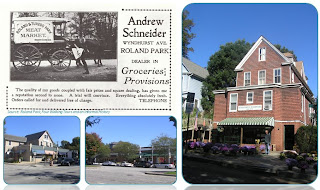
Shopping opportunities in and adjacent to Roland Park
Quite an important concept of the movement, Howard's Garden City would be a place for everyone. This was far from the truth in Roland Park. Sadly, "the suburban world of leisure, family life, and union with nature was based on the principle of exclusion"(Fishman, 4). With the strict and legally mandatory covenant introduced by Bouton and the Roland Park Company, Roland Park legally excluded many groups of people. In 1910, residents were required to sign the covenant, which excluded African Americans. In that same year, department stores were segregated and racial tensions were most extreme. Three years later, Jewish residents were also barred. Unfortunately, Roland Park had set an example and many other Baltimore neighborhoods would soon follow this model. But it was not only the covenant that kept out certain people; the houses generally had a minimum value, making them unaffordable for some (Ames). This requirement, in addition to the fact that the cost of commuting by rail, though not entirely unmanageable, meant living in Roland Park was too expensive of a lifestyle for most members of the working class. This lifestyle became an expression of the upper class. With the establishment of the Baltimore Country Club in 1898, this separation of classes was exaggerated even more.
The Garden City movement had made its way back across the Atlantic to America, but it wasn't until a few decades later. By the 1900s, Roland Park was well underway, and so it's not very likely the movement had much influence on Roland Park's designs. One thing, however, can be said of Roland Park and the Garden City Movement: it is alike other Garden City developments in that nearly all Garden City endeavors failed to meet the principles outlined by Howard. Most attempts at Garden City design are better classified as Garden Suburbs, rather than Garden Cities. These places were still almost wholly dependent on nearby cities; they were not as large as Howard's Garden City populated by 30,000; in fact, they were quite the exact opposite of what Howard prescribed for his Garden Cities. It's hard to ignore the patterns of certain blocks in Roland Park and how they resemble these sorts of derivatives of Howard's concept. It may perhaps be coincidental and not at all because of direct influence, but the designs of areas like Merryman's Court and Ridgewood Corner, in Plats 5 and 2, are surprisingly comparable to developments like Hampstead Garden Suburb, the first Garden Suburb. In these two parts of Roland Park, a grouping of houses are set facing a common green area, a frequent element used in Garden Cities. Even the architectural styles are evocative of the English vernacular architecture used in Hampstead and other Garden Suburbs. In regards to its social intentions, the Garden City movement cannot be clearly seen in Roland Park. The common Garden Suburb, however, and Roland Park can be equated.
Just three years after the members of the Roland Park Company had come together, something grand was happing in the Midwest. In 1893, The World's Columbian Exposition had opened in Chicago. The Expo is best known for its impressive architecture, emphasis on civic design, and the Beaux Arts value of joining disciplines- art, architecture, sculpture, landscape design- in the city development process. These principles became a part of the City Beautiful Movement. The resulting designs expressed grand, neoclassical architecture; civic monuments; and the establishment of cultural institutions. The influence of the City Beautiful Movement is more obvious in the cultural buildings of Roland Park, such as the Enoch Pratt library, the municipal water tower, and St. Mary's Seminary- the last of these three being perhaps the best example of City Beautiful architecture, and one of Baltimore's most recognizable landmarks today. The homes along Goodwood Gardens, West of Roland Park, a street once referred to as "Millionaire's Row," are also great examples of this movement. Their designs are grand explorations in residential architecture. For the most part, however, Roland Park residences were humble, yet sophisticated structures rather than an exploration of the City Beautiful.
Similarities between a Garden City and Roland Park
In 1940, the rail line was removed from Roland Avenue as the automobile had become the frontrunner in intra-city travel. Eight years later, the Supreme Court ruled that the restrictive covenant which restricted African Americans and Jews from living in Roland Park was illegal. Roland Park has gone through some changes, but for the most part remains unchanged. Many original trees still remain, and ones planted by Bouton have since grown. It's likely Roland Park wouldn't look anything like this today if it weren't for the strict covenants and careful planning that went into its design. And it is precisely that planning that has given Roland Park the status it holds today as one of the earliest planned communities that happens to be home to the nation's first shopping center. It has been a model and leader for many communities to follow. As we've seen with the racially barring covenant, that hasn't always been proven a good thing. However, Roland Park had been inspiration for communities across the country and remains so today. With modern-day planning movements, it is a reference. The narrow paths set behind houses serve as service lanes where the unattractive necessities of single family living (trash pick-up, electrical wiring, and automobile parking) can take place. This is a practice that the New Urbanists currently promote in their Traditional Neighborhood Developments.
Garage access via service lane
Whether for good or for ill, Roland Park has always been of an exemplary design. It was a learning process from the beginning, and we have certainly gained the issues it met and how they were overcome. A model community of various planning movements, the neighborhood has received recognition many times over. Now, holding national status, this old neighborhood in Baltimore continues to mature and grows ever more romantic, garden-like, and beautiful.

Bibliography:
Ames, David L., and Linda F. McClelland. "National Register Bureau Suburbs Part 2: Historic Residential Suburbs: Guidelines for Evaluation and Documentation for the National Register of Historic Places." U.S. National Park Service - Experience Your America. National Register Publications, 2002. Web. 10 Oct.

Campbell, Scott, and Susan S. Fainstein. Readings in Planning Theory. Malden, MA: Blackwell, 2003.
Howard, Ebenezer. To-morrow: A Peaceful Path to Real Reform.
Jackson, Kenneth T. Crabgrass Frontier: the Suburbanization of the United States. New York: Oxford UP, 1985.
LeGates, Richard T., and Frederic Stout. The City Reader. London: Routledge, 2007.
Lewand, Karen. North Baltimore, from Estate to Development. Ed. D. Randall. Beirne. Baltimore, MD: Prepared by Baltimore City Department of Planning and the University of Baltimore, 1989.

Messner, Rebecca. "Olmsted's Shortcuts | General Home & Design." Urbanite Baltimore Magazine. 1 July 2011. Web. 14 Sept. 2011.
Roland Park Civic League. Greater Roland Park Master Plan. Baltimore, 2010. Print.
Wilson, William H. The City Beautiful Movement. Johns Hopkins University Press. Baltimore, MD, 1989. 
The above text and presentation images are from a report studying an historic Baltimore City project [my chosen project being the planned community of Roland Park] as its creation and development relate to planning movements. It is the resulting coursework of an History of City and Regional Planning seminar in Morgan State University's City and Regional Planning Graduate Program.

Monday, September 5, 2011

Washing Laundry Without the Help of a Machine


In Honor of Zero-Waste Week: Living Waste-free

September 5-11 is Zero-Waste Week, and to kick it off, I'll talk about some improvements I have made in my life to live waste-free. I have been on the waste-free kick for a while, but most intensely in the last 2 years. It began with removing the trash from my "brown-bagged" lunches (check out that article here), and it has progressed in all aspects of my life.

Now, just standard recycling and re-purposing is something I've been doing since childhood. What I'm talking about here is serious cutting back of the amount of non-recyclables that get "disposed". Think about it, we throw out plastic baggies, food containers, tissues, toilet paper, paper towels, used/old/broken items, among millions of other tiny things every day. With each toss, it might seem trivial, but it adds up quickly. We don't see the the piles of waste growing and growing, though, now do we? No, but others do. That's because wealthy countries like the United States actually export their garbage (and not always legally)! We don't want to deal with the messes we create, so we send them off to less fortunate communities all around the world. That's the American way, I suppose, but American isn't the only country to participate in such trades.

All this because we are raised to live the consumer lifestyle. Not everything we use, however, is consumed. Thus a lot more ends up in landfills than we would like to admit. For more information, take a look at this video, "The Story Of Stuff":


Upsetting isnt' it? Well, that's why we need to cut back. In every room of the house, there are steps you can take to eliminate waste. In the kitchen, use sponges and reusable towels, not paper towels, to clean up messes; or using jars and tupperware to store food, not plastic baggies. In the office, you cut back by recycling paper, and even reusing one-sided paper for notes; or switching to electronic filing and messaging. But what about in the bathroom? The bathroom is one of the biggest waste creating rooms in the house (both biological and garbage waste). Here are some tricks for getting rid of waste in the bathroom.

Waste-Free in the Washroom

I'm going to be talking about garbage waste today, perhaps down the road I'll get into composting toilets, but for now, we'll just address the many toiletries and beauty items that are used each day.

We all have our routines, and there are a few basic hygiene habits we all carry out (or should). Let us take a look at my personal morning and evening routines and evaluate the neo-traditional method of executing the task, and how it can be done waste free.

The alarm goes off. I have poor vision, so I either reach for my glasses or my contact lenses. Contact lenses are a waste, but for my lifestyle, most days I go for them first. In their defense, contact lenses use much less plastic as framed glasses do. You would need to use thousands of contact lenses, I'm sure, before you would have the same amount of plastic needed to create glasses. One study explains,
The overall environmental impact of waste generated thorough the use of contact lens products by the end consumer is insignificant (0.5%) compared with the amount of waste generated in our everyday life.
Either way, permanent glasses or replaceable contact lenses aren't having an enormous effect on the waste plastics industry.

So, after that less than satisfactory waste-limited step in the morning routine, I head to the bathroom. First, I wash my face. Traditionally, I would use a cleanser that came in a plastic bottle, or a bar soap that was wrapped in a cardboard box. Plastic and cardboard can usually be recycled, but depending on the plastic used for the bottle and your local recycling initiative, or the inks and coating on the cardboard, these items are sometimes trash and not recyclables. Even if they were recyclables there is still the aspect of creating single use containers. My changed behavior is now buying bar soap that comes without any packaging. I use Sappo Hill's Oatmeal Soap to cleanse and exfoliate.

After I was my face, I will apply a toner or astringent. To apply, I would use a cotton ball, and one often wasn't enough to apply the product to all of my face, my neck and my chest. So I would use and dispose of multiple cotton balls each time. Mind you, I wash my face each night as well, so we're talking at least 4 cotton balls thrown out each day, maybe 6 or more. Instead of buying and throwing away cotton balls, you can invest in reusable cotton rounds, which can be used, kept, cleaned and reused. Better for Grownups makes a set you can purchase online at Amazon.com. Finally, in the face prepping routine, I apply moisturizer. This process, however, still has me buying recyclable plastic containers. I have yet to explore a solution to this issue.


The next step in my routine is to brush my teeth. Before, I would use a toothbrush made of virgin plastic, and often one that used way more plastic than necessary to make. Now, I use a BPA-free plastic toothbrush made from recycled yogurt cups. I take advantage of Preserve's Toothbrush Subscription program. For $13 a year, I have a toothbrush mailed to me every 3 months, and the old toothbrush is sent back and recycled. It is 100% post-consumer, and the brush and the mail packaging is all recyclable. I will try this program for the next year, and perhaps later explore other alternatives, such as a wooden handle and natural bristle brush. This type of a brush could be composted or used in a woodburner.

After I brush my teeth, I'll apply deodorant. A couple months ago, I invested (a measly $7) in a deodorant stone. Made of mineral salts, it is an alternative to the deodorant sticks sold in convenience stores. I have used the stone with varying degrees of success. Because it is not an antiperspirant, I still have to use a natural deodorant on top of it. I think it's something that will be more beneficial in the winter months. In the summer, however, when I limit my A/C usage and participate in high-impact activities, I still use a natural deodorant. Right now, I use Tom's Natural Deodorant. I love Tom's product, though I haven't been too thrilled with the deodorant. The Daily Green rates other natural deodorants here. If you're interested in the deodorant stone you can buy it, like the reusable cotton rounds, from Amazon.com.


In the shower, I also use a Preserve razor which, like the toothbrush, uses little plastic to begin with and is 100% post-consumer. I know I can count on Preserve to make quality recycled products. For soap, I again choose a Sappo Hill brand soap that is bought without packaging.

There are many other ways to save waste in the bathroom. When discussing waste-free habits, I don't think we can ignore energy usage. Living inefficiently and irresponsibly in terms of energy/electricity is a major waste. My brother showers in the dark. Fortunately for me, I have a window in my bathroom, so I just rarely turn on the lights. And you can always be green when you can't be waste-free. Saving water is key as well. I never leave the water running while brushing my teeth, while lathering my hair, while shaving, or while washing my face until it's time to rinse; and shower time is always limited.

I obviously left out a lot of my routine here, and that's simple because cosmetics, shampoos/conditioners, etc don't always have waste-free solutions (See the links in the last section for alternatives I have not yet explored). In these cases, the ingredients used in your products are just as important. If there's something you can't buy as a reusable, buy a natural and organic alternative to today's neo-traditional standards instead. It takes a while to get into a new habit, but after that, it's easy being green.

Finding Alternative Alternatives
There are some waste-free alternatives I have not yet tried. For example...
  • In addition to green toothbrushes, there are options for flossing as well. If you have a store like Whole Foods, MOM's Organic Market, Trader Joe's, or another natural market nearby, you may want to check if they have dental floss made of natural, not synthetic, fibers. Also remember that less packaging is always more. No dental floss? Opt for natural, wooden toothpicks. (The only reason I haven't switched to natural dental floss is because a couple years ago I bought a couple years worth of floss that worked with the REACH® Access® Flosser. I see now that it's a lot of plastic to accompany such a little bit of floss, but I bought it at a time when I needed incentive to make me floss in the first place, this made it easy. My policy, however, is to use what I have until it's been exhausted [so long as it doesn't affect my health] instead of throwing out perfectly usable products.)
  • Instead of liquid shampoo in a plastic bottle, there are bar shampoos. Check out the list of bar shampoos on Nature Mom's Blog.
  • I don't know of any waste-free conditioners, but you can create your own hair conditioning treatments. Last week, I made a banana, honey and egg hair conditioner
  • I also am not familiar with any waste-free makeups. Until I know of any, I buy organic, natural, mineral makeup that doesn't use the dangerous and unhealthy chemicals that impregnate cosmetic aisles and counters across the country.

Resources:
1) The Story of Stuff. Web. 05 Sept. 2011. .
2) Rufus, Anneli, and Kristan Lawson. "Exporting Garbage What's the Deal with Rich Countries Shoving All Their Trash to Developing Countries?" Mother Nature Network. 6 May 2008. Web. 5 Sept. 2011. <http://www.mnn.com/money/sustainable-business-practices/stories/exporting-garbage>
3) Rastogi, Nina Shen. "Contact Lenses Produce Trash, but Their Environmental Impact Is Minimal." The Washington Post: National, World & D.C. Area News and Headlines - The Washington Post. 26 Jan. 2010. Web. 05 Sept. 2011. .
4) "Environmental Impact of Three Replacement Modalities of Soft Contact Lens Wear." PubMed. Eurolens Research, 26 Mar. 2003. Web. 05 Sept. 2011. .
5) Zissu, Alexandra. "Best Natural Deodorants - 9 Natural Deodorants You Can Trust - The Daily Green." Going Green, Fuel Efficiency, Organic Food, and Green Living - The Daily Green. Web. 05 Sept. 2011.